 Use cases
Five AI use cases for technical teams
Five tasks of a technical team end to end: what it takes, what to measure and when not to.
Use cases
Five AI use cases for technical teams
Five tasks of a technical team end to end: what it takes, what to measure and when not to.
Five AI use cases for business and operations, step by step
When a company asks where to start with AI, the useful answer is not a list of tools: it is one concrete task told end to end. These are the five cases we have started with most often in business and operations, each with what it takes to implement it, what to measure and when it is not worth it. If what you are after is the whole approach rather than the cases, it is in the approach for business.
How to read these cards
Each case shows the same task twice: how it is done today and how it looks with AI implemented. What is struck through in the "today" column is the manual work that disappears; where a person is still working, even with help, nothing is marked.
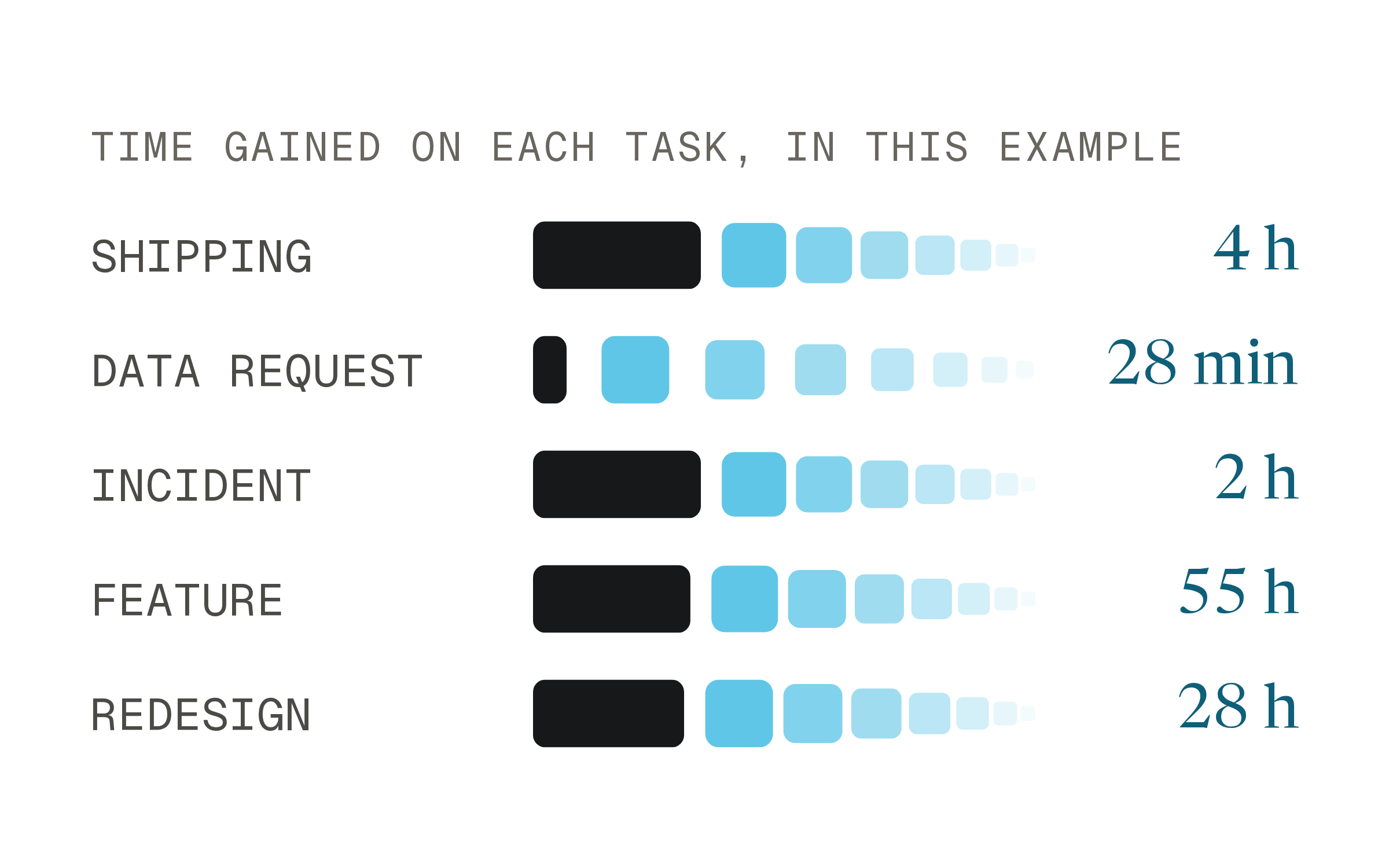
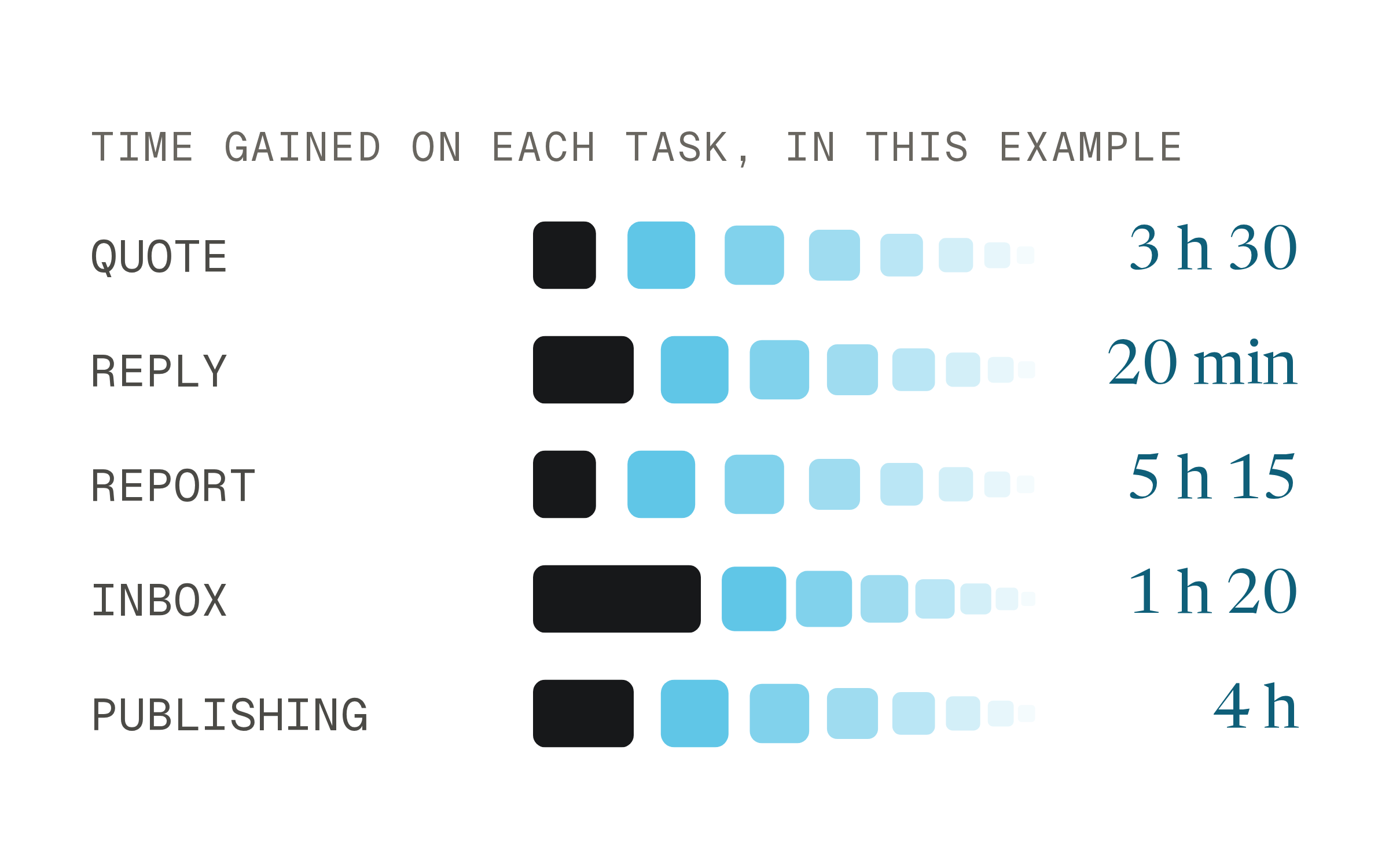
The hours come from one real example, not an average across clients and not a promise. They show where the weight of the task sits, not what return to expect. And in all five cases a person is still deciding: what gets automated is the preparation, not the judgement.
01 · Preparing a quote
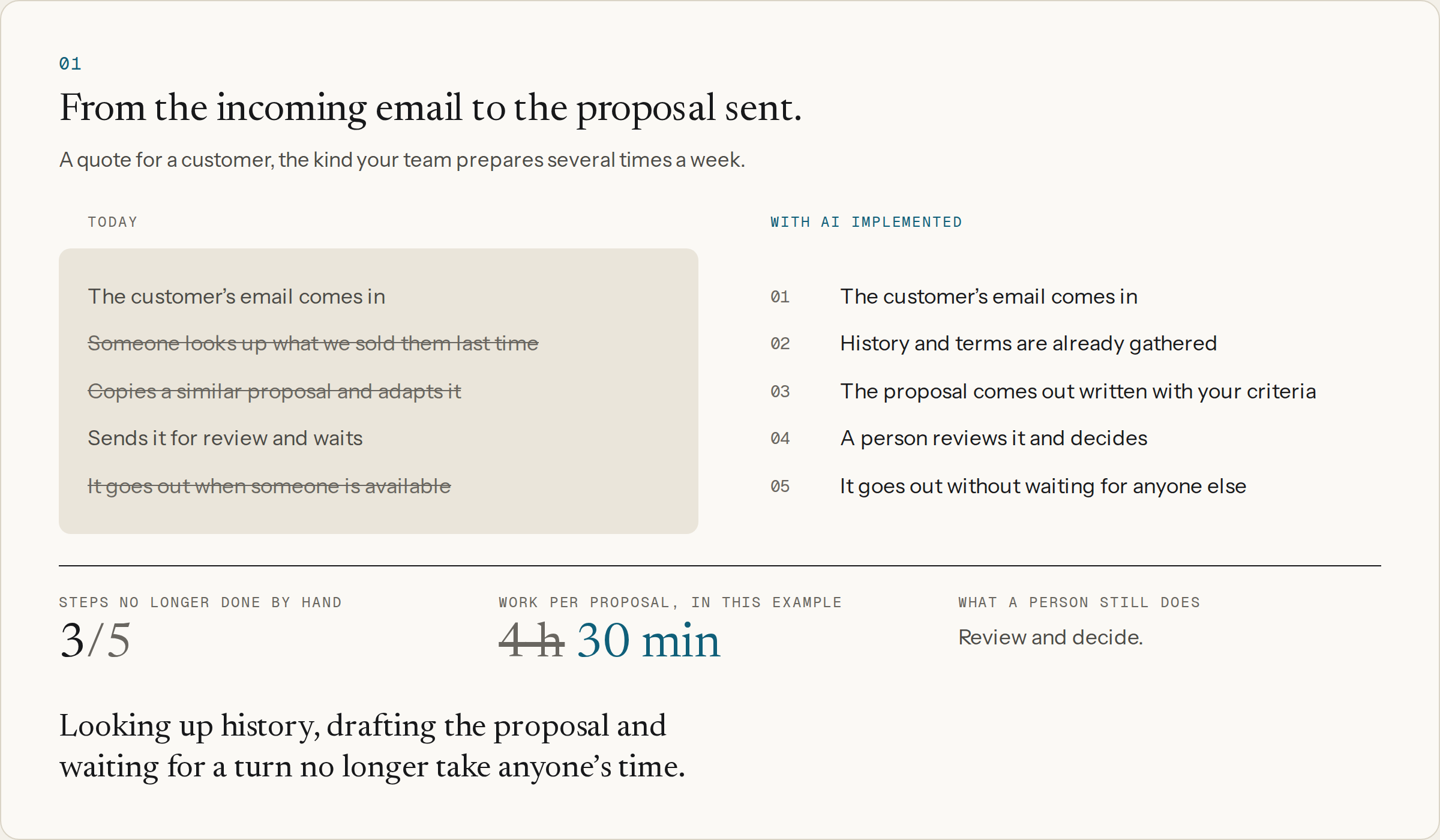
What it takes. Read access to the CRM or to wherever sent proposals live, the commercial terms written down —volume discounts, payment terms, what is never offered— and a template with the fixed blocks separated from the variable ones. The terms are the part you cannot skip: without them, what gets generated invents the margin.
What to measure. Hours per proposal, proposals that go out the same day the request comes in, and the share that is sent without correcting the price.
When it is not worth it. If every quote is a different project and no two are alike, there is no pattern to learn. And if the price is negotiated from scratch every time, drafting is not the expensive part.
02 · Answering a customer
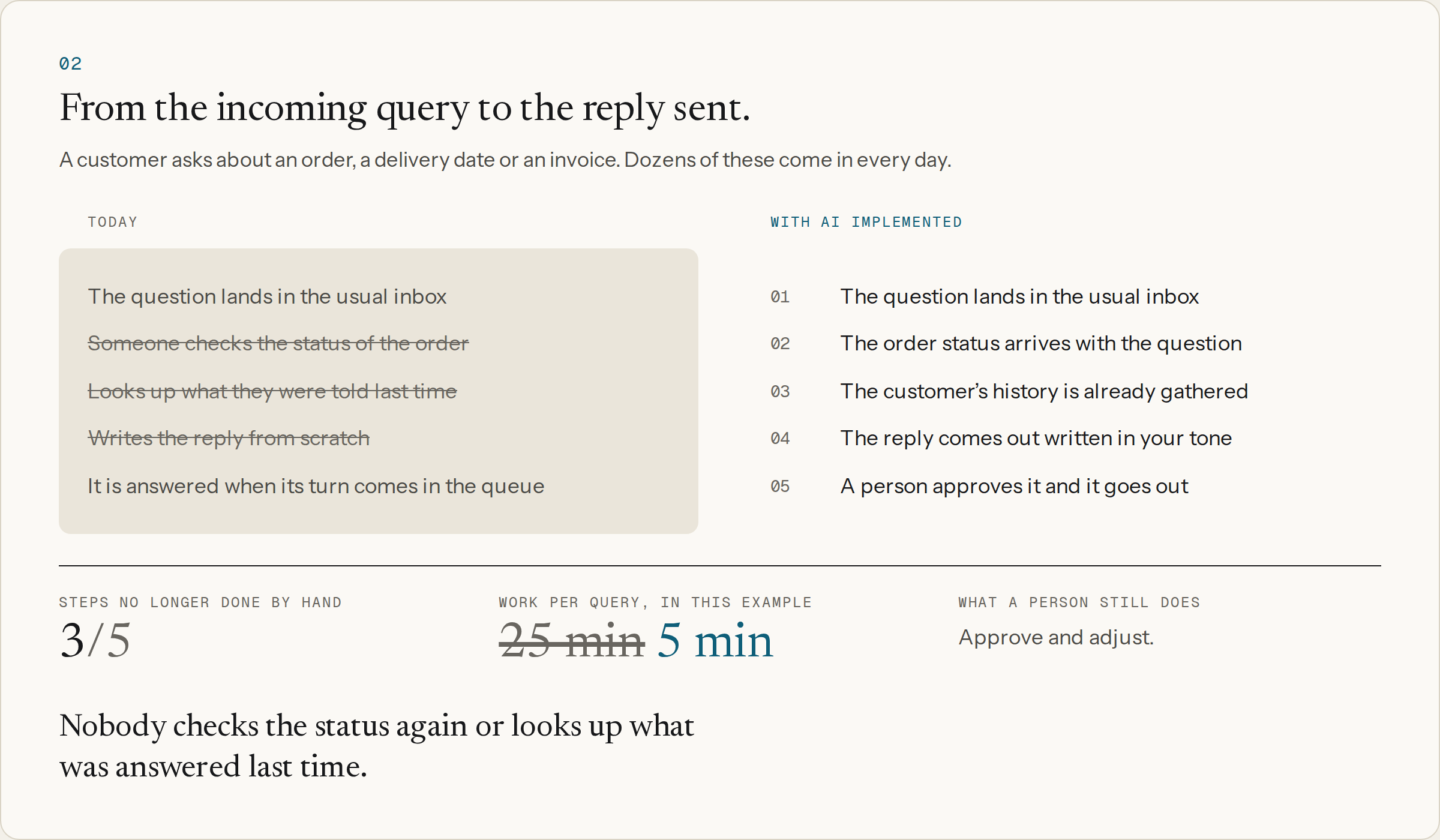
What it takes. Order status readable from wherever it lives —ERP, storefront or order manager—, the conversation history with that customer, and a written list of what gets answered on its own and what always escalates to a person: returns, complaints and anything involving money.
What to measure. Time to first reply, queries resolved without anyone stepping in and, above all, reopened threads. That last number is what tells you the answer was good; the other two only tell you it was fast.
When it is not worth it. Below a dozen queries a day, the saving does not pay for the integration. And if order status is not readable from any system, that is the problem to solve first.
03 · Closing the report
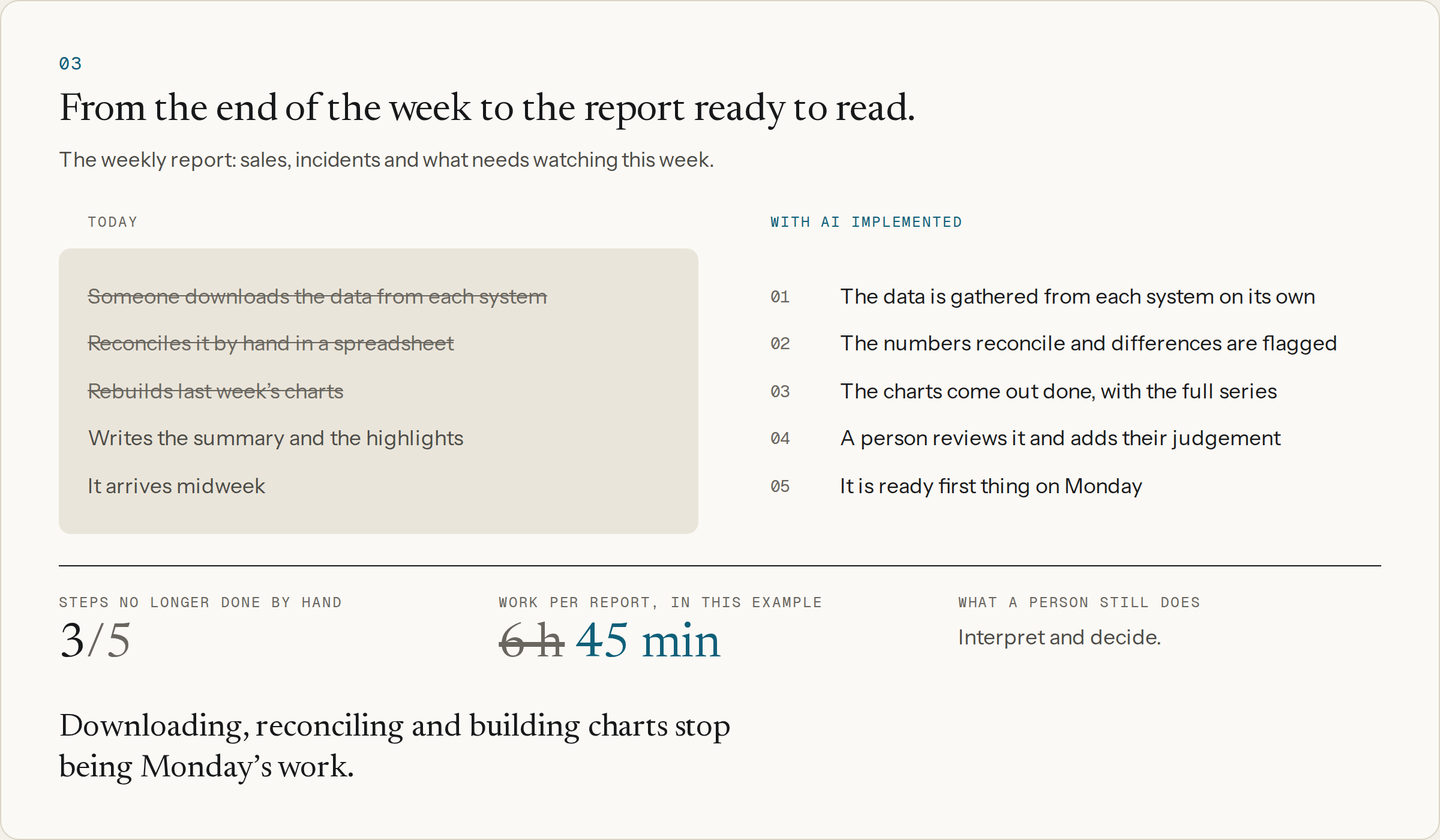
What it takes. Read access to each source and, more importantly, a written definition of every metric: what counts as a sale, on what date, with or without returns. That is where Monday's hours actually go. Not into downloading data, but into arguing about why two systems give different figures.
What to measure. Hours until the report exists, differences between systems caught automatically versus the ones that slip through, and how many Mondays it is ready first thing.
When it is not worth it. If nobody reads the report, automating it only makes it cheaper to ignore. Before implementing, write down which decision depends on it; if there is none, the case is to retire it.
04 · Sorting the inbox
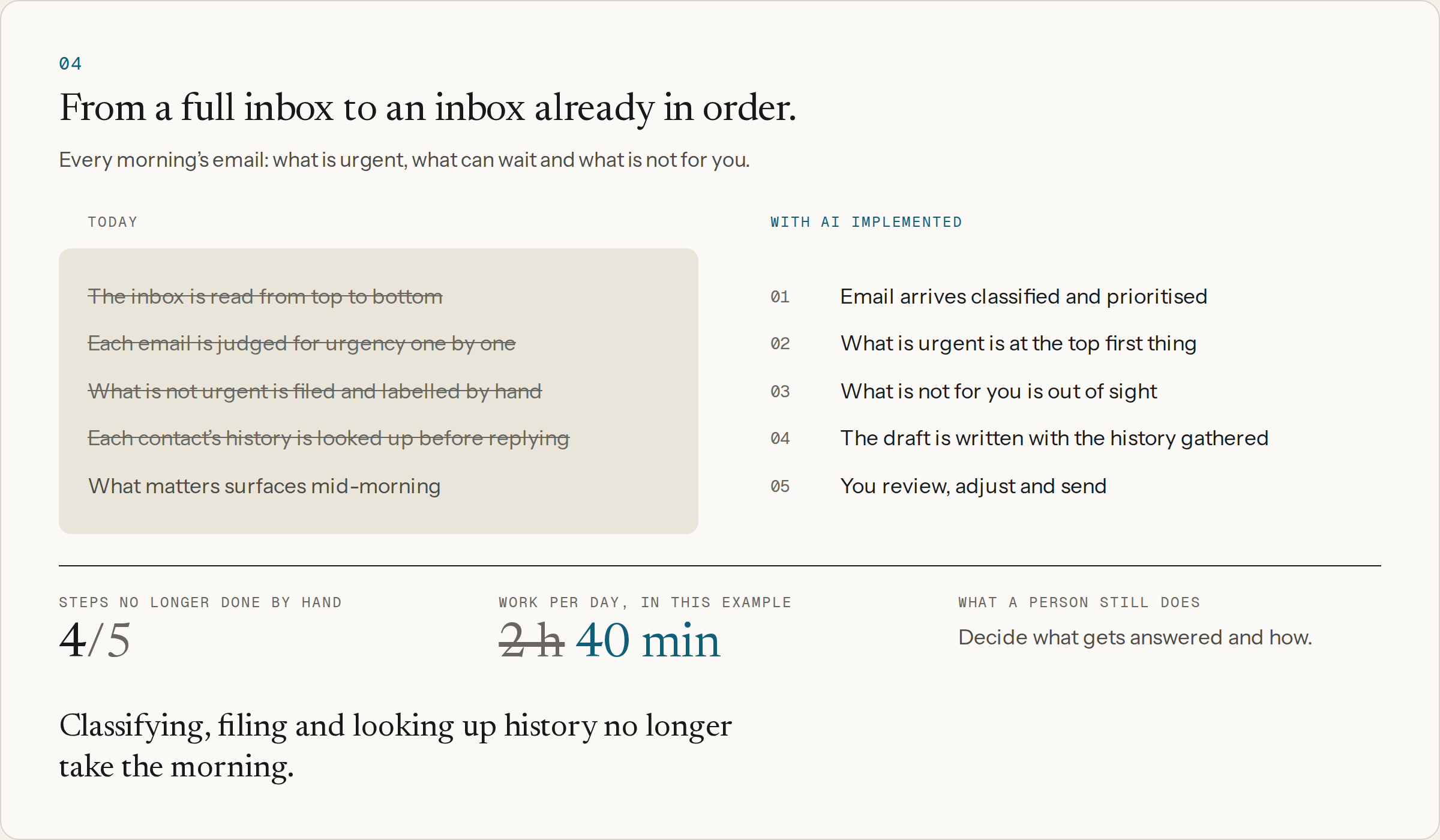
What it takes. Priority rules written by the person who receives that mail, not generic ones, and the rule for what is never filed away. It is the case that depends most on one person and, for that reason, the one that best teaches how to write criteria: by the second attempt the difference between "urgent at the top" and a rule you can actually check is obvious.
What to measure. Minutes until you reach the first email that matters, and important emails that ended up in the wrong folder. Watch that second number: one false negative costs far more than ten false positives.
When it is not worth it. If the inbox is already under control, there is nothing to gain. And if two people on the same team prioritise differently, you need two written sets of criteria, not one compromise that serves neither.
05 · Publishing and sending
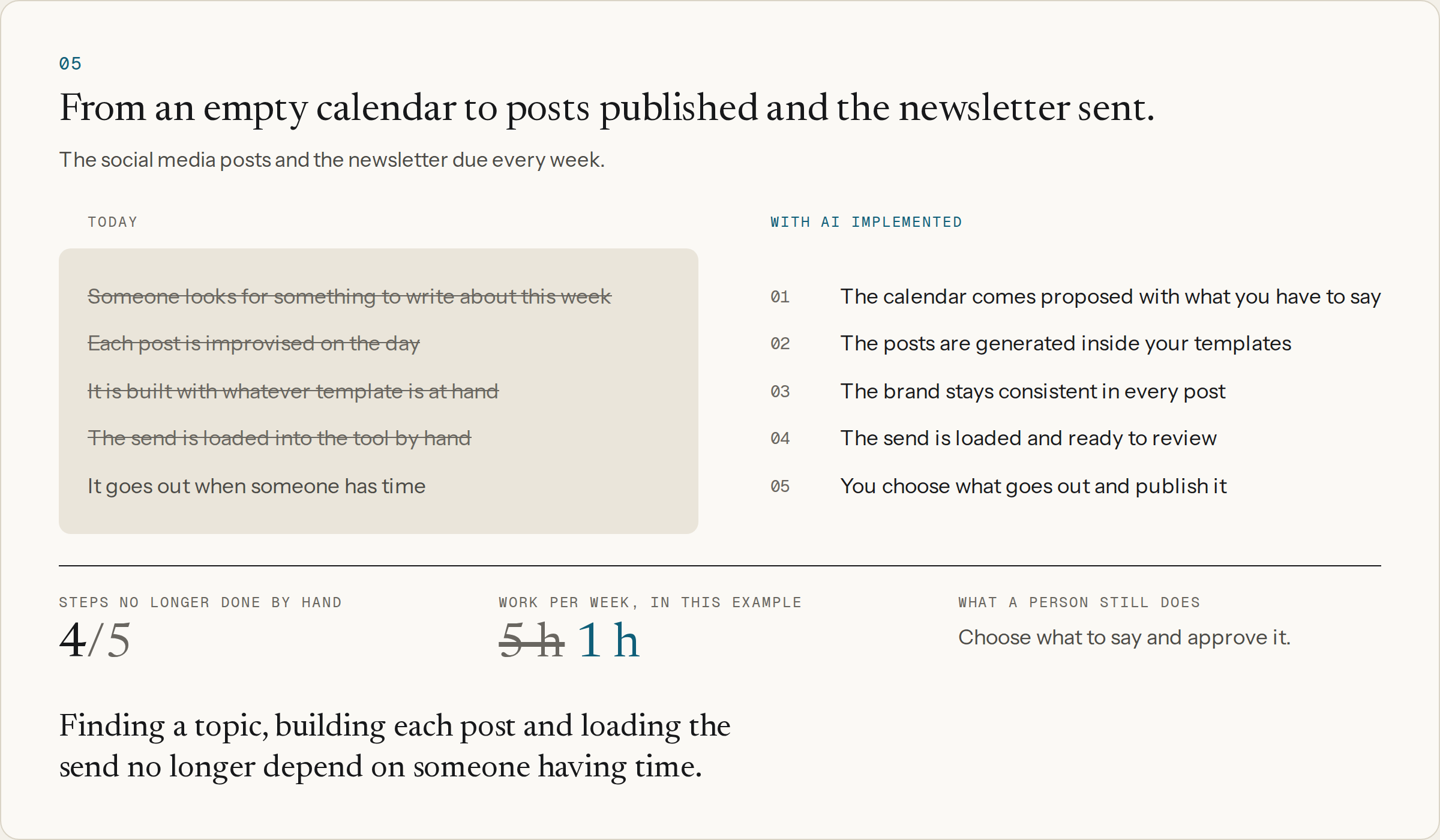
What it takes. The brand templates, a readable archive of what has already been published —so you do not repeat yourself and can keep a thread going— and the tone written down with examples of what works and what does not. The negative examples do the real work: without them the output reads as correct and sounds like nobody.
What to measure. Posts published per week, time per piece and corrections per piece. The third is what tells you the criteria are well written: if it falls week after week, the loop is closed.
When it is not worth it. If the brand has no defined tone yet, what gets generated will invent one and change it every week. That work comes first, and it is done by a person.
Which of the five to start with
The first case is not chosen for how impressive it is, but for what it leaves learned. Of these five, the two that depend least on anything else are answering a customer and sorting the inbox: they repeat every day, the result is visible immediately, and the criteria can be written in an afternoon.
Closing the report saves the most arguing, but it requires agreeing first on what each figure means, and that is already half a project. Preparing a quote has the most impact per unit and depends most on having the terms written. And publishing and sending is the one that goes worst if you start without a defined tone.
The full set of criteria we use to filter a first case —it repeats, it needs judgement that lives in one person, it can be verified, the data exists, and nothing breaks if it fails— is in the article where we explain how we work.
These five are the most common, not the only ones: the full catalogue sorts them by the part of the company they affect, and there is a version of this list for technical teams. If you want to see how they fit the way you work, you can ask for information with no commitment: if it is not a fit, we will tell you.
Keep reading
Use cases
Five AI use cases for technical teams
Five tasks of a technical team end to end: what it takes, what to measure and when not to.
 Use cases
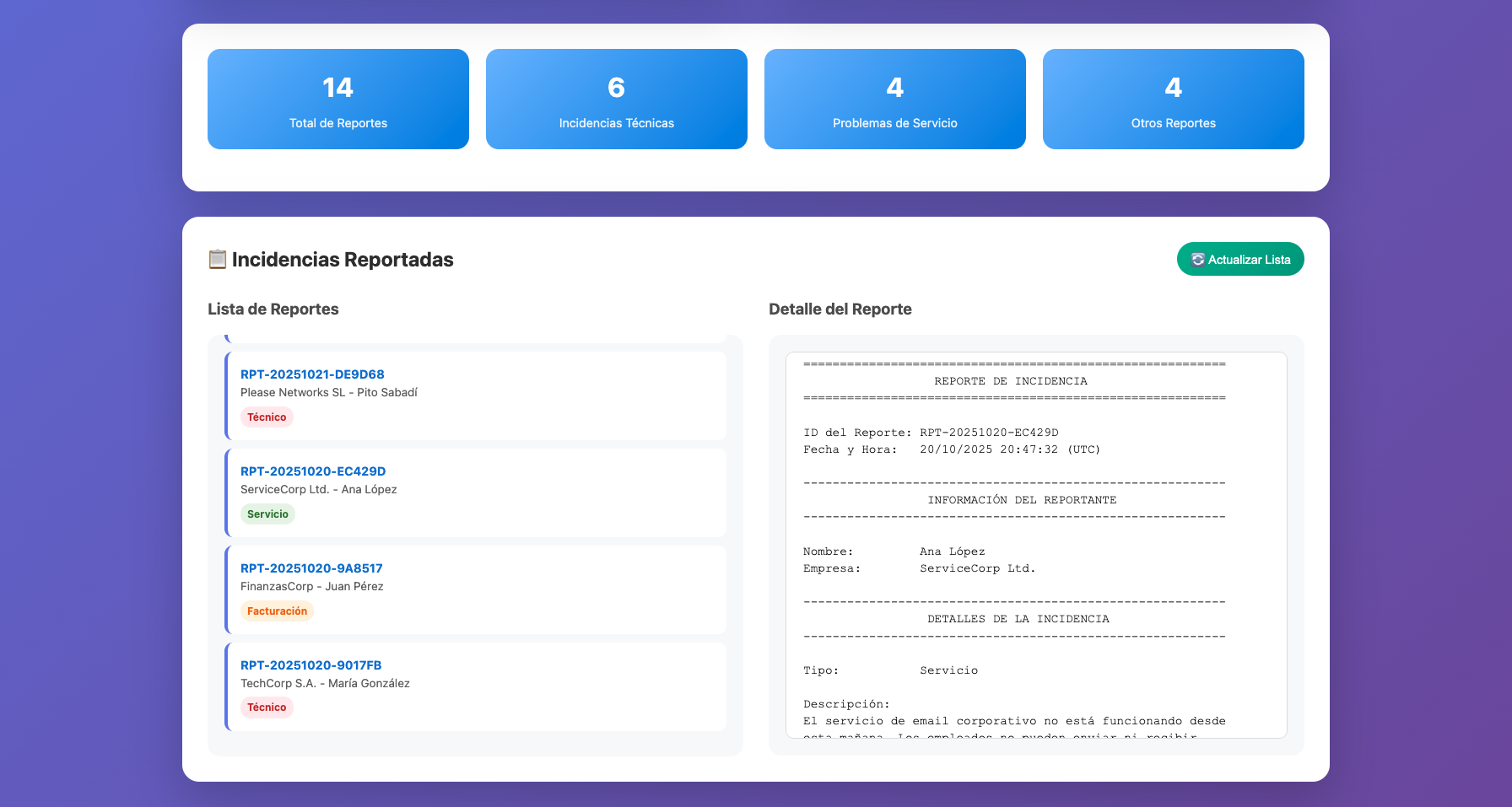
Interactive demo: Enterprise Phone Agent
Interactive Phone Agent demo: complete phone automation for businesses 24/7.
Use cases
Interactive demo: Enterprise Phone Agent
Interactive Phone Agent demo: complete phone automation for businesses 24/7.
 Use cases
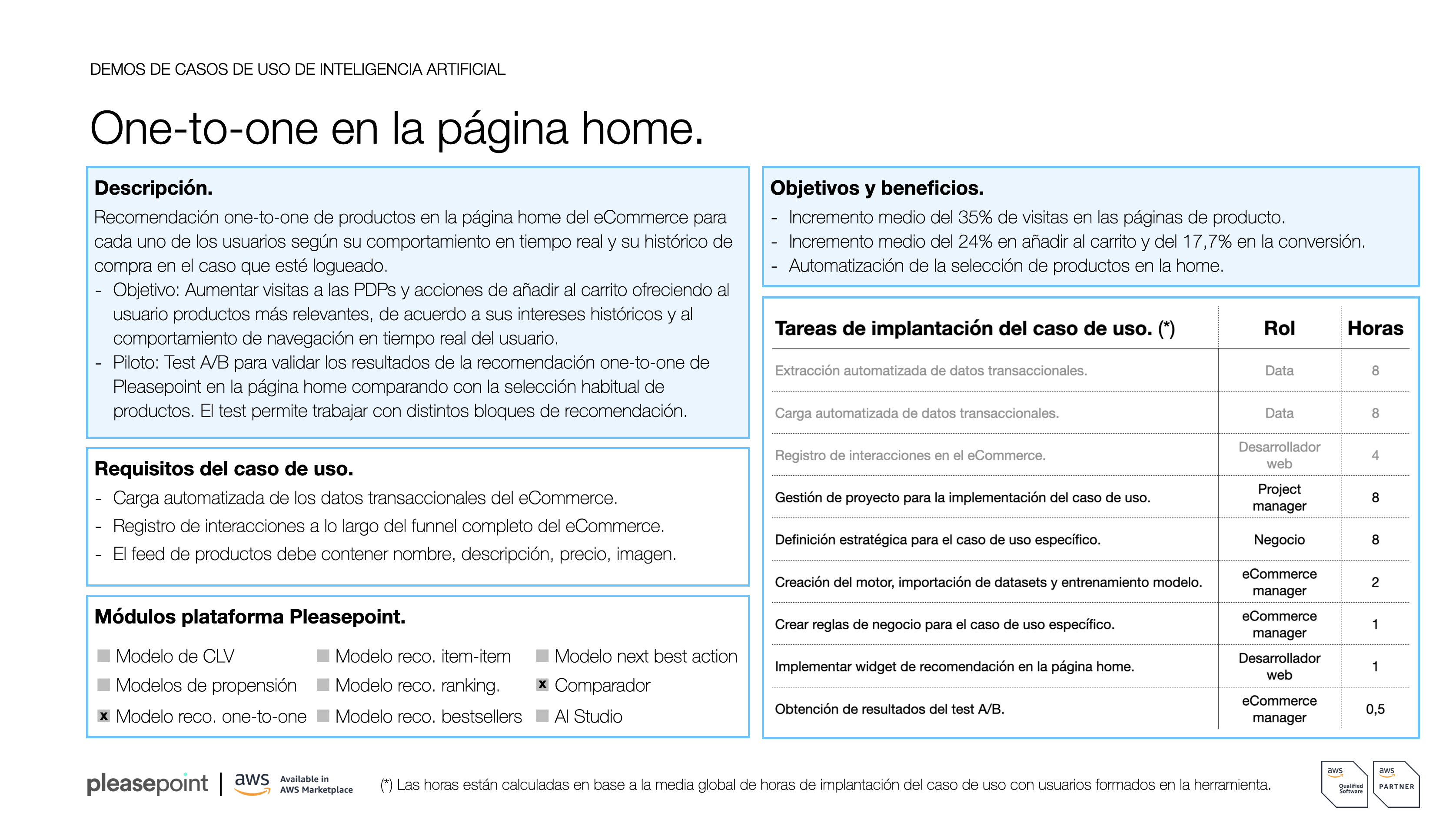
Use case: One-to-one personalization of the homepage.
In this article, we show how one-to-one personalization transforms the shopping experience in an eCommerce.
Use cases
Use case: One-to-one personalization of the homepage.
In this article, we show how one-to-one personalization transforms the shopping experience in an eCommerce.
Shall we talk about your case?
Tell us how your team works today. We will tell you whether there is something worth implementing, and if there is not, we will tell you that too.
No commitment
You talk to the person who will do the work
If it does not fit, we tell you