 Guides
AI implementation agency or consultancy: how they differ
One hands over a diagnosis; the other leaves the case running inside your systems.
Guides
AI implementation agency or consultancy: how they differ
One hands over a diagnosis; the other leaves the case running inside your systems.
Almost every company uses AI, only 6% see it in their EBIT
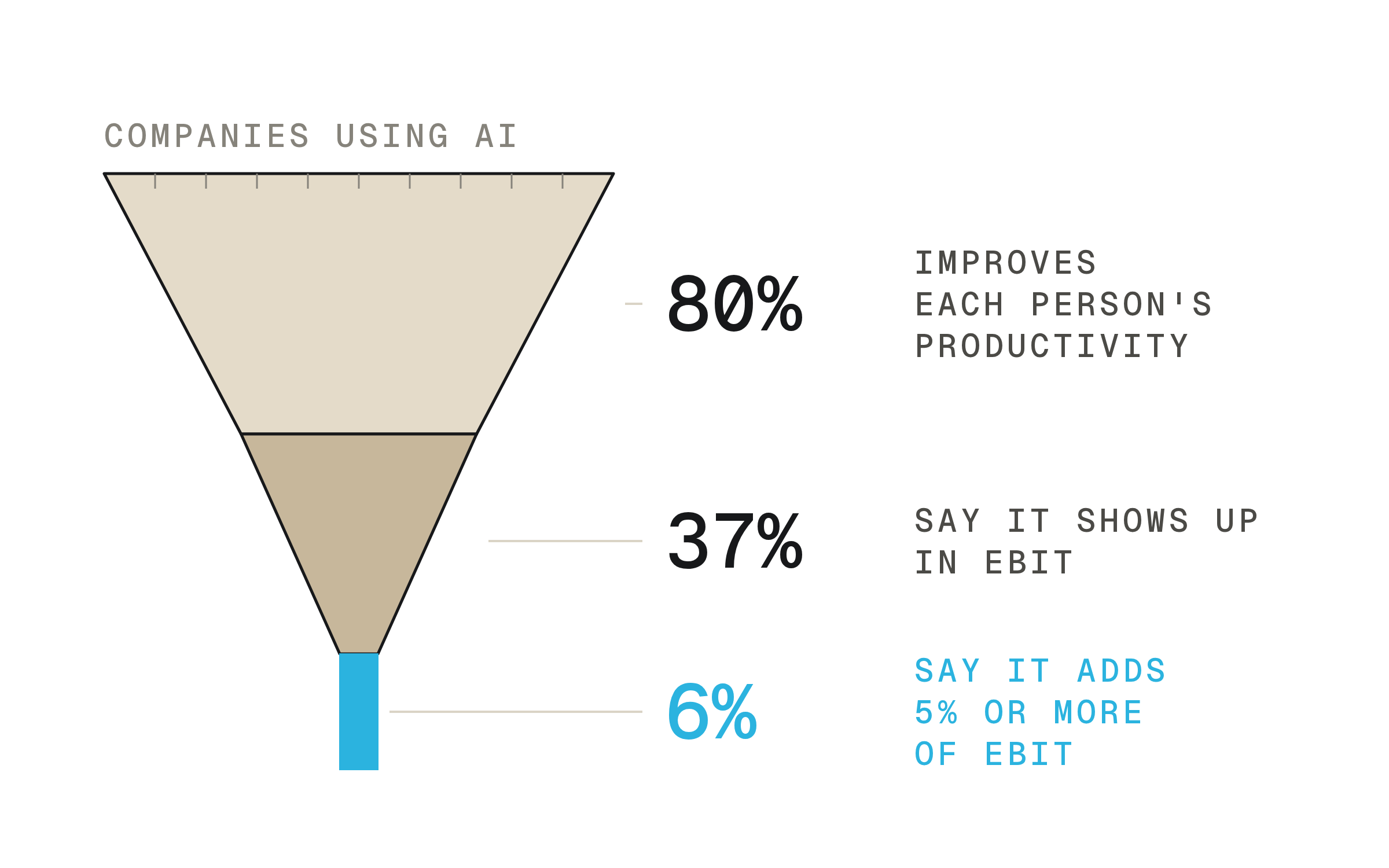
Nearly nine in ten companies now use AI regularly. Only 37% say it shows up in their EBIT. And 6% attribute 5% or more of their result to it, according to McKinsey's latest report.
What separates those three groups is not the model they use. It is the work they have given AI to do.
The AI that shows up in EBIT replaces an invoice
When a company uses AI to work faster, the team performs better and the spend stays the same. Those salaries were already paid. The result does not move.
When AI takes on work that used to be paid for outside, the spend falls. And that spend sits right above the result.
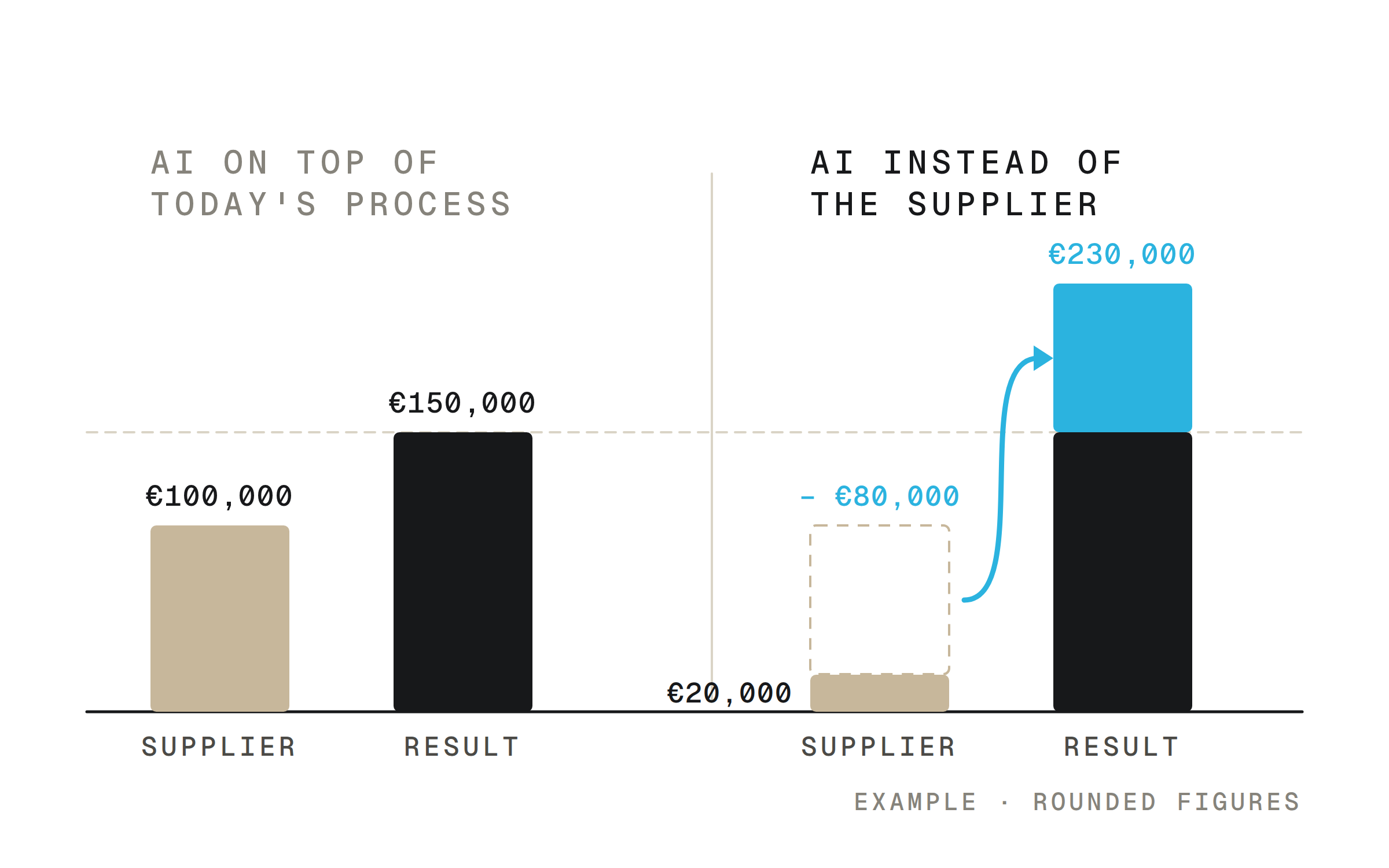
Picture a company with €1.5 million in annual revenue that pays €100,000 to a supplier for repetitive work done at a computer. If it brings 80% of that work in-house, this is what changes:
| Today | With 80% in-house | |
|---|---|---|
| Supplier invoice | €100,000 | €20,000 |
| Operating result (EBIT) at a 10% margin | €150,000 | €230,000 |
| Growth in the result | +53% |
These are example figures, rounded so the arithmetic is easy to follow. That company sells no more and hires no one: someone already on the team spends a few hours a week validating what the AI produces. And its result grows by more than half.
Why most companies do not see it in their accounts
The figures come from The state of AI in 2026: On the road to ROI, published by McKinsey in August 2026 with 1,719 responses collected in May and June.
The report finds that 80% of respondents see an improvement in individual productivity, and that only 37% attribute any EBIT impact to AI. That second figure is the same as a year earlier, even though both AI use and the number of companies scaling it across the organisation have grown.
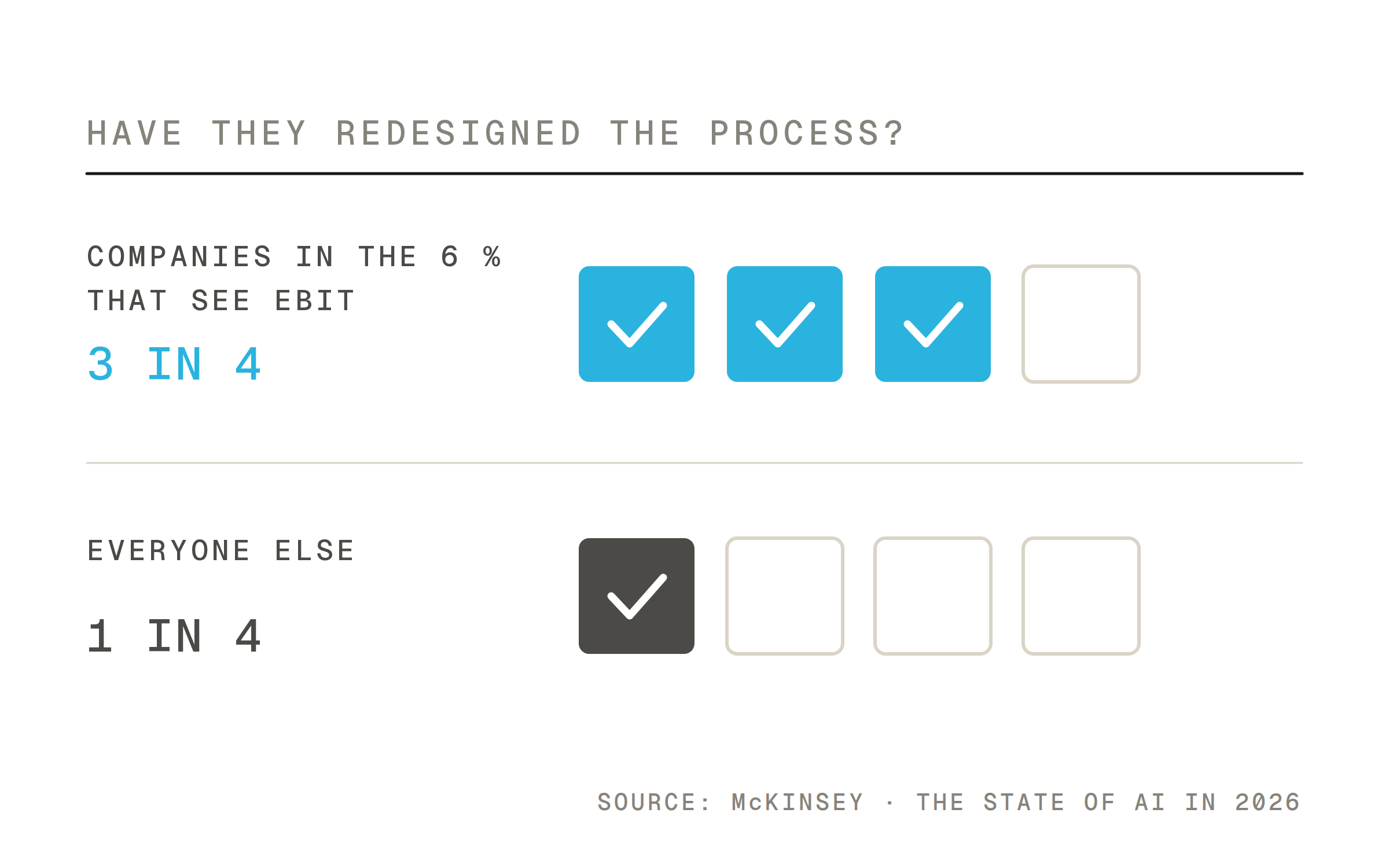
The explanation lies with the group that does get there. McKinsey calls AI high performers those who attribute 5% or more of their EBIT to AI and describe the impact as significant. They are 6% of respondents. Nearly three in four have redesigned their processes, against one in four among everyone else: they redesign the workflow instead of inserting AI into the one they already had.
Redesigning a process does not mean changing everything. It means changing who does each step.
The pattern: AI executes, your team validates
The four steps are the same in any sector:
- The work arrives the way it arrives today: a document, an order, a request, a file.
- AI prepares and executes it following written rules, the same ones the supplier follows today.
- It flags whatever is unclear instead of deciding on its own.
- Someone in the company validates the result and resolves what was flagged.
The outcome is a new split. The repetitive work leaves the supplier, the judgement stays inside, and the supplier moves to covering peaks and exceptional jobs.
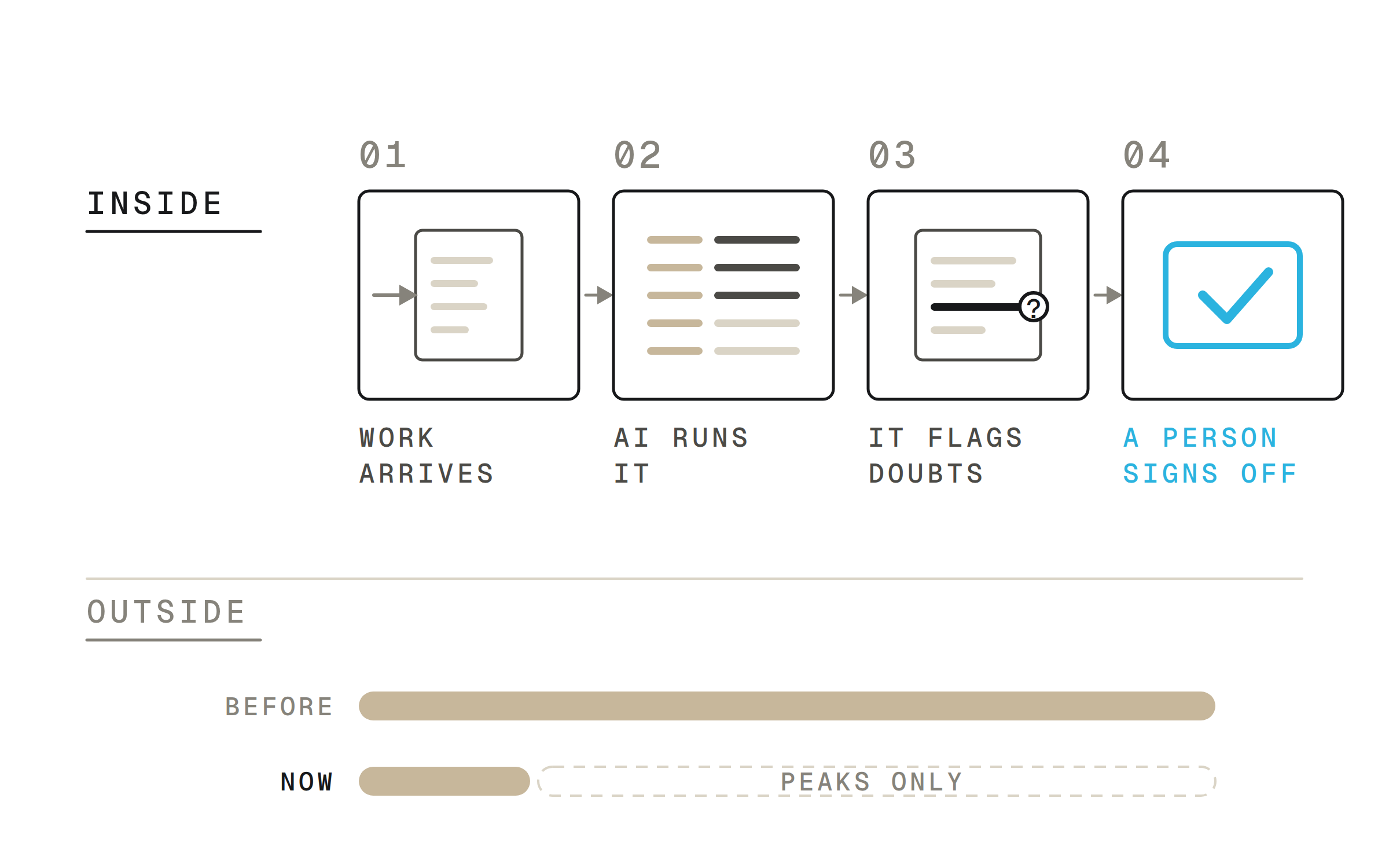
That fourth step is not a detail: it is what makes the process hold up. Nobody signs off work that nobody has reviewed. How this gets built, phase by phase, is set out on the AI implementation page.
Four conditions that tell you whether a process qualifies
Before building anything, the candidate process has to meet four conditions. If one fails, it is not where to start:
- The rules can be written down. There are templates, regulations, a manual or a criterion someone can dictate.
- The volume repeats. Many similar jobs each year, not one-off projects.
- The result can be checked. You know whether it is done right, and you know by looking.
- Someone inside can validate it. Without that person, the work cannot be brought in-house.
A worked example
At a publisher, that work is typesetting books: the author's Word file arrives, AI applies the series styles and builds the structure, and the typesetter does the fine-tuning and signs it off. It is set out with numbers in the article on AI typesetting.
The same pattern shows up in product description translation, technical documentation, tender writing and document review. The trade changes, the mechanics do not. The catalogue lists the cases we implement, one by one.
Where to look in your own accounts
The first step needs neither us nor any technology. Open the balance sheet and look at two lines: work outsourced to other companies, and services from independent professionals.
Write down every supplier that invoices you for work done at a computer, with its annual amount. Run that list through the four conditions. Whatever is left standing is your queue of candidates, ordered by amount.
What the 6% do differently
Three things, and none of them is technological.
They pick a process that generates an invoice today, instead of spreading AI across the whole company.
They change how the work is split, instead of adding a tool to the current process. That is the redesign McKinsey measures.
They measure from before they start. According to the report, those companies are twice as likely to have defined processes for measuring impact and leadership committed to the project. If the baseline is taken once the system is already running, there is nothing to compare. And with nothing to compare, the project never reaches the meeting where budgets are decided.
Which supplier invoices you every month?
Tell us what that supplier does and how much it invoices you each year. We will tell you whether it meets the four conditions and how much can be brought in-house. Write to us: no commitment, you talk to the people who will do the work and, if it is not a fit, we will tell you.
Keep reading
Guides
AI implementation agency or consultancy: how they differ
One hands over a diagnosis; the other leaves the case running inside your systems.
 Guides
Implementing AI: the three phases and what you get
The nine deliverables of an implementation, three per phase, and what it takes from your side.
Guides
Implementing AI: the three phases and what you get
The nine deliverables of an implementation, three per phase, and what it takes from your side.
 Guides
Introduction to predictive marketing.
Use predictive analysis techniques to forecast customer behavior and optimize your marketing strategies.
Guides
Introduction to predictive marketing.
Use predictive analysis techniques to forecast customer behavior and optimize your marketing strategies.
Shall we talk about your case?
Tell us how your team works today and where it gets stuck. We look at whether there is something worth implementing and, if there is not, we tell you that too.
No commitment
You talk to the person who will do the work
If it does not fit, we tell you